HEALTH AND RISK FACTORS
UNDERSTANDING HEALTH RISKS
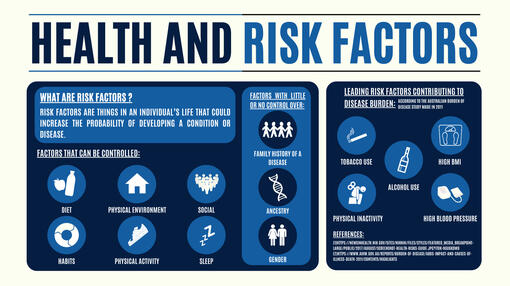
Health risks are all around us. A sneeze that happened near you can increase the likelihood of catching the flu. Obesity can boost the odds of having diabetes in the future. And smoking heightens the risk for many cancers. And though sometimes understanding health risks is confusing, it is crucial. Knowing what risks you face can help find ways to prevent health problems. It can also stop you from worrying about unlikely causes. But first, what is considered a health risk anyway? Risk factors are things in an individual’s life that could increase the probability of developing a condition or disease. Risks don’t guarantee that something would happen but do imply that there is a possibility. Behavioral risk factors are factors that individuals can change or alter. Biomedical risk factors are bodily states that are frequently influenced by behavioral risk factors.
RISK FACTORS AND DISEASE BURDEN
Taking control of one’s well-being partly requires understanding the risk factors for different illnesses. Risk factors can increase the chances of getting a certain infection. A few risk factors are past control such as being born with them or exposed to them. Family history of a disease, ancestry, and gender are some of the risk factors that one has little or no control over. Meanwhile, diet, physical environment, habits, and physical activity are some of the risk factors that can be controlled.
According to the Australian Burden of Disease Study made in 2011, the leading risk factors contributing to disease burden were: tobacco use, high body mass index, alcohol use, physical inactivity, and high blood pressure. An analysis of the joint effect of all 29 risks included in the study suggested that they accounted for 31% of the total burden of disease and injury in Australia in 2011.
CHANGING YOUR WAYS
As stated by the National Institutes of Health, there are several ways of handling the situation when you are at increased risk for a disease or condition. One of the ways is doing research and educating yourself. Learning about health risks can help you decide what action to do next. Another way is to talk to your doctor or health care provider. With their help, you can precisely determine what your health risks are.
In addition, it has been estimated that almost 35 percent of early U.S. deaths in the year 2000 could have been avoided by changing just three behaviors:
STOPPING SMOKING
Stopping smoking gives you more energy. It also gives a boost to your immune system, making it easier to fight off colds and flu. Your blood circulation also improves within 2 to 12 weeks of stopping. This makes physical activity, including walking and running, much easier to do.
GETTING MORE PHYSICAL ACTIVITY
Getting at least 30 minutes of physical activity every day is very beneficial for our body. Try to find time for exercise for extra health and fitness benefits. A great way to get your body active is by dancing! Not only will it reduce your risk of a heart attack, but it would also make you feel better – with more energy and a much better mood.
EATING A HEALTHY DIET
Eating more fruits and vegetables can reduce cancer risk. Other than that, a 2015 study made by Strasser and Fuchs, found that a healthful diet containing Vitamins C, D, and E may help maintain cognition and brain health.
BASIC JAZZ DANCE STEPS
NEIL HARRY SO
INTRODUCTION TO JAZZ
Jazz dance is a fun aerobic exercise that allows dancers to express themselves through a wide range of movements. It is often energetic and improvised. All jazz dancers interpret the accompanying music in a unique way (RealBuzz Team, 2017). As a result, the steps, turns, twists, or big leaps incorporated into the choreography are of the dancers’ own creativity and aesthetics. However, do not be discouraged if the idea of creative dance does not apply to you. In this article, I will take you through the basic jazz dance steps that you can use to create your amazing dance choreography.
BASIC JAZZ DANCE STEPS:
1. CROSS-POINT
One of the iconic movements in jazz dance is cross-point. It is similar to walking; but the legs move in a particular direction and order. This dance step also serves as great practice for individual movements or gestures on the lower body (Hanson, n.d.)
The steps for cross-point are as follows:
a. Step the right foot diagonally to the left.
b. Point the other foot sidewards with aligned toes.
c. Repeat with opposite movements.
Reminder: Make sure that your knees are bent all throughout the execution.
2. FORWARD AND BACKWARD STEP
This is a simple, yet effective warm-up for your legs that increases the heart rate in preparation for intense exercise routines.
The steps for forward and backward step are as follows:
a. Start with the feet together and arms at the side.
b. Step the right foot in place.
c. Step the left foot forward, backward, or sideward.
d. Repeat with opposite movements.
3. KICK-BALL-CHANGE
Kick-ball-change is a jazz movement used across all genres of dance from ballet to hip-hop (WonderHowTo, 2010).
The steps for kick-ball-change are as follows:
a. Start with the feet together and arms at the side.
b. Kick the right foot forward, without going above the shin height.
c. Tap the right foot lightly down its ball, next to the other foot.
d. Step the left foot in place.
4. STEP-BALL-CHANGE
Similar to kick-ball-change, this next step is also one of the first steps that jazz beginners learn.
The steps for step-ball-change are as follows:
a. Start with the feet together and arms at the side.
b. Step the right foot sideward.
c. Tap the left foot lightly down its ball, next to the other foot.
d. Step the left foot in an oblique direction to the left.
Reminder: Try to keep your hips on the same direction and angle as you execute this technique.
5. JAZZ SLIDE
This dance step requires coordination between the head, hands, and feet. While performing jazz slide, the hip of the leg bent is tilted towards a lunge, which gives the body an asymmetrical image. Additionally, the arms are to be extended obliquely, making them parallel to the extended leg (Jazz Dance Basics- Locomotor Movements in Jazz Dance, n.d.).
The steps for jazz slide are as follows:
a. Start with the feet together and arms at the side.
b. Step the left foot forward with arms crossed.
c. Slide to the right with the arms in the second fundamental position and eyes looking at the middle finger.
d. Close with the left foot.
6. PADDLE TURN
Paddle turn is a jazz movement that can be used in ballroom dancing. It involves a simple turn either to the left or right by pivoting the body around.
The steps for paddle turn are as follows:
a. Start at the second position with arms placed at the side.
b. Paddle the right foot around four corners to return to your original position.
c. Repeat with opposite movements.
7. Grapevine
This is a perfect jazz movement to add to your exercise routine for a better lower-body workout. It targets the glutes, thighs, and calves (McKenzie, 2019). In most aerobics classes, grapevine step is also used to improve balance and agility.
The steps for grapevine are as follows:
a. Cross the left foot obliquely to the right.
b. Abruptly switch the position of the feet to the right.
c. Switch the position of the feet to the right once more.
d. Point the right foot sideward.
e. Repeat with opposite movements.
8. STAR JUMP
What is a better way to end this list than with a jumping exercise that pushes your body off the floor? This sudden burst of energy is helpful in strength training or cardiovascular endurance.
The steps for star jump are as follows:
a. Start with the feet together and arms at the side.
b. Bend knees and jump at the count of 8. (count 5,6,7,8)
c. As you jump high, extend arms in a V-position and face your palms toward the crowd.
d. Land back in your starting position with knees bent and arms at the side.
As you have seen, the basic jazz dance steps are incredibly easy to perform. Take your time to practice and master these steps. As your skills increases, you may also add different combinations of arm movements into your dance routine. Therefore, next time you hear your favorite music playing, execute these steps properly and you’ll surely own the dance floor.
Learn and Watch from the links below:
- CROSS-POINT
- Forward and Backward Step
- Kick-Ball-Change
- Step-Ball-Change
- Jazz Slide
- Paddle Turn
- Grapevine
- Star Jump
Human beings are vulnerable at their core
Quijana Samilo